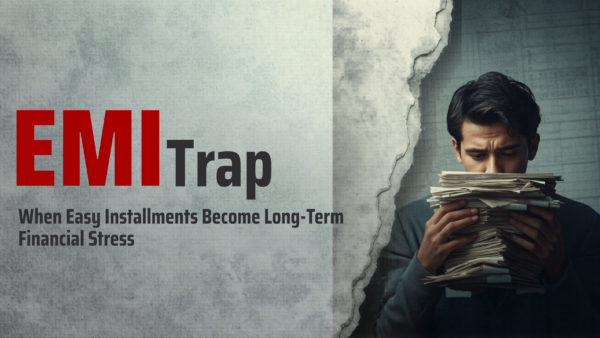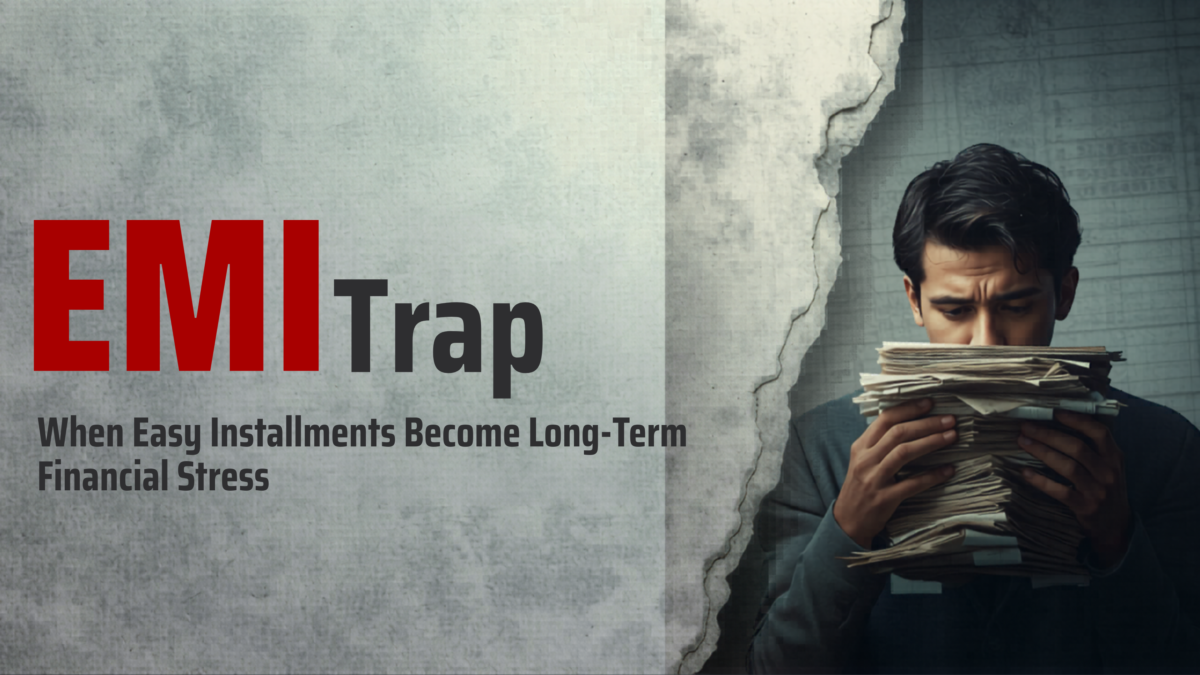
It started with one easy EMI.
Then another. Then one more, because the offer was too good to ignore. Now a significant chunk of your salary disappears before you even decide where it goes — and the weight of it sits somewhere between your chest and your monthly bank statement.
You’re not imagining it, and you’re not bad with money. This is exactly how EMIs are designed to feel.
The Trick EMIs Play on the Human Mind
“Just ₹7,999 a month.” “Less than what you spend on coffee.” “Easily manageable with your salary.” You do the mental math, glance at your bank balance, and think: yes, I can handle this.
And you probably can — for now.
The problem is that monthly instalments don’t register as real borrowing. They feel like planning. Instead of focusing on the total cost, your brain zooms in on one number: the monthly payment. As long as that number fits your salary, everything feels fine.
That’s what makes EMIs so persuasive. They turn a ₹15 lakh car into “just paying ₹25,000 a month.” A ₹10 lakh purchase becomes a “smart decision” the moment it’s broken into pieces small enough to feel invisible.
Why EMI Problems Have Become So Normal in India
A decade ago, taking a loan was a considered decision — paperwork, a branch visit, a waiting period, a conversation with a bank manager. That friction was inconvenient, but it also created a natural pause to think before committing.
That friction is almost entirely gone now. Today, EMI offers begin with a single tap: buy now, pay later, zero down payment, no-cost EMI, instant approval, pre-approved offers sitting in your inbox. According to reporting by the Economic Times, a large share of borrowers struggling with EMI stress end up spending over 40% of their income on repayments — often turning to costlier lenders to keep up.
The Real Cost Hidden Behind Small Numbers
Here’s what most people misunderstand: a low monthly payment doesn’t mean a low total cost. Often it means the opposite. A longer tenure lowers your EMI, but stretches out the interest you pay — sometimes adding up to more than the price of the item itself.
Before agreeing to any EMI, ask for three numbers, not one:
- The total amount you’ll repay by the end of the tenure
- The total interest you’re paying, in rupees, not just as a percentage
- What that same monthly amount could become if invested instead, over the same number of years
Why It Still Feels Stressful Even When You Pay on Time
This is the part most people don’t talk about. You check your bank balance. The EMI is deducted. You’re on time again. So why does it still feel heavy?
The stress isn’t really about missing payments — it’s about what an EMI does to your relationship with money over time:
It commits your future income. Every EMI you agree to is a claim on money you haven’t earned yet. You’re promising that future-you will show up with that amount, every month, regardless of what changes — a job loss, a medical emergency, a slower year for your business.
It shrinks your flexibility. Multiple EMIs running at once mean less room to say yes to opportunities (a career change, an investment, a move) because your salary is already spoken for before it lands.
It normalizes borrowing as the default. Once EMIs become the usual way you buy things, saving up in advance can start to feel unnecessary — even though it’s almost always cheaper.
Breaking the Cycle: A Practical Framework
- Add up every active EMI you’re currently paying. Most people underestimate this number until they write it down.
- Calculate it as a percentage of your take-home salary. As a general guideline, many financial planners suggest keeping total EMI obligations under 40% of your monthly income — though the right number depends on your job stability, dependents, and existing savings.
- Before your next purchase, ask for the total repayment figure, not just the monthly one. Use our EMI Calculator to see the real cost side by side.
- Separate “can I afford the EMI” from “do I actually need this.” The first question is about cash flow. The second is about whether the purchase fits your actual priorities.
- If you’re already stretched thin, consider whether prepaying a high-interest loan is a better use of extra cash than starting a new one — see our Prepay vs Invest guide for a framework on that decision.
EMIs aren’t inherently bad — they make genuinely useful purchases (a home, an education, a vehicle you need for work) possible without waiting years to save the full amount. The trap isn’t the tool. It’s mistaking “I can afford the monthly payment” for “I’ve thought through the total cost.”
This article is for educational purposes and does not constitute financial advice. Loan terms, interest rates, and eligibility vary by lender — confirm exact figures with your bank or NBFC before borrowing.