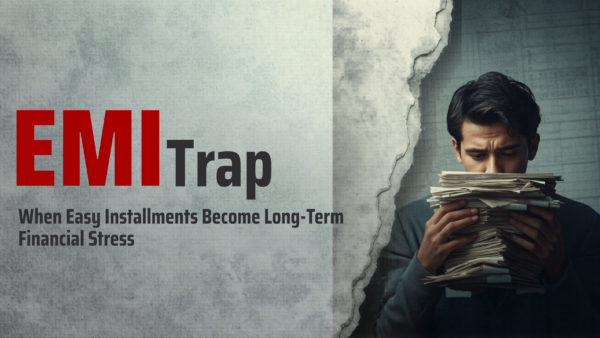
Nobody teaches us how money actually works — not school, not parents, not anyone. Here’s the guide the Indian middle class truly deserves.
You get your salary on the 1st. By the 20th, you’re wondering where it all went. Sound familiar? You’re not alone. Millions of Indian middle-class families earn a decent income but still feel financially stuck — not because they don’t earn enough, but because nobody ever handed them a clear financial roadmap.
This guide changes that. Step by step, in plain language, no jargon — just practical money moves built for the Indian salaried life.
Step 1
Track Every Rupee — Know Where Your Money Goes
You can’t fix what you can’t see. Before budgets, before investments — start with awareness. Write down every expense for 30 days: rent, groceries, Swiggy orders, chai at the canteen, the random Amazon impulse buy.
- Use a free app like Walnut, Money Manager, or even a notes app.
- Categorise everything into: Needs, Wants, Savings.
- Most people are shocked to find ₹3,000–₹5,000 leaking monthly on things they barely remember buying.
Step 2
Build a Budget That Doesn’t Feel Like a Punishment
The simplest budgeting system for salaried Indians is the 50-30-20 rule. It’s flexible, realistic, and actually works:
|
50% Needs (rent, EMIs, groceries) |
30% Wants (dining, OTT, travel) |
20% Savings & Investments |
If you earn ₹50,000 a month, aim to put ₹10,000 towards savings and investments — every single month. Not what’s left over. First.
Step 3
Build Your Emergency Fund — Before Anything Else
Life in India is unpredictable. A job loss, a hospital emergency, a sudden home repair — any of these can derail your finances overnight. Your emergency fund is your financial shock absorber.
- Target: 3–6 months of essential expenses (single income); 9–12 months for self-employed or variable income earners.
- Keep it in a separate savings account or liquid mutual fund — accessible within a day, not mixed with daily spending money.
- Only dip into it for genuine emergencies — not wants, not “almost emergencies.”
Step 4
Get Out of Bad Debt — and Stay Out
Credit card debt at 36–42% annual interest is the single biggest wealth destroyer for the Indian middle class. Personal loans aren’t far behind. Eliminating them is your top financial priority — it’s a guaranteed “return” equal to the interest rate you’re paying.
- List all debts: balance, interest rate, minimum payment.
- Attack the highest-interest debt first (avalanche method) while paying minimums on everything else.
- Never spend on a credit card what you can’t pay fully at month-end.
Step 5
Start Investing — Even ₹500 a Month Counts
Saving money in a bank account is not investing — it quietly loses value to inflation every year. Wealth is built by putting money to work. Here’s what works best for the Indian middle class:
- SIP in Mutual Funds: A Systematic Investment Plan lets you invest from ₹500/month. It harnesses rupee cost averaging — you buy more units when markets are low, fewer when high — smoothing out volatility over time. Perfect for salaried professionals.
- PPF (Public Provident Fund): Government-backed, completely tax-free returns under Section 80C. Ideal for conservative, long-term wealth building. 15-year lock-in, but the interest earned is 100% tax-free.
- ELSS Mutual Funds: Equity Linked Saving Scheme — market-linked growth plus tax savings under 80C, with just a 3-year lock-in. The best of both worlds.
Step 6
Protect What You Build — Insurance Is Not Optional
One medical emergency without health insurance can wipe out years of savings. With India’s medical inflation running high, insurance isn’t a luxury — it’s the foundation of financial safety.
- Term life insurance: If you have dependents — parents, spouse, children — a term plan is non-negotiable. Buy a cover of at least 10–15x your annual income. Premiums are cheapest when you’re young and healthy.
- Health insurance: Don’t rely only on employer coverage — it ends when the job ends. Get a personal family floater plan of at least ₹10–15 lakh cover.
Step 7
Plan for Retirement — the Earlier, the Easier
Retirement feels distant at 25 or 35. But the math is unforgiving: ₹1,000 invested at 25 compounds into far more than ₹1,000 invested at 45. Time is your most powerful financial asset — and it doesn’t come back.
- NPS (National Pension System): Market-linked pension with an additional tax benefit of up to ₹50,000 under Section 80CCD(1B) — over and above the ₹1.5L limit under 80C.
- PPF + ELSS SIP combo: A classic, tried-and-tested retirement strategy — safe government returns blended with equity growth over 20–30 years.
Personal finance is not about being rich. It’s about being free — free from financial anxiety, free from living paycheque to paycheque, free to make choices without money being the obstacle.
The Indian middle class is resourceful, resilient, and hardworking. What it often lacks isn’t income — it’s a clear, simple system to manage that income. You now have one.
Start with step one. Track your spending this week. Then move to step two. You don’t have to do everything at once — you just have to start.
Your future self will thank you.
Found this useful?
Share it with someone who needs to hear this. And explore more no-nonsense money guides at theplotline.in
Sources
NSDL Primer on Personal Finance
Middle Class Hub — Money Management Tips for Indian Middle Class Families
HDFC Life — How to Save Money for Middle Class Family
Kotak Life — Best Savings Plans for Middle Class India
Finnovate — Emergency Fund India: The 3-6-12 Rule
ClearTax — Mutual Funds for Salaried Individuals
PolicyBazaar — SIP Investment Guide 2026
Tata AIA — Complete Guide on Investment Plans for Middle Class India